
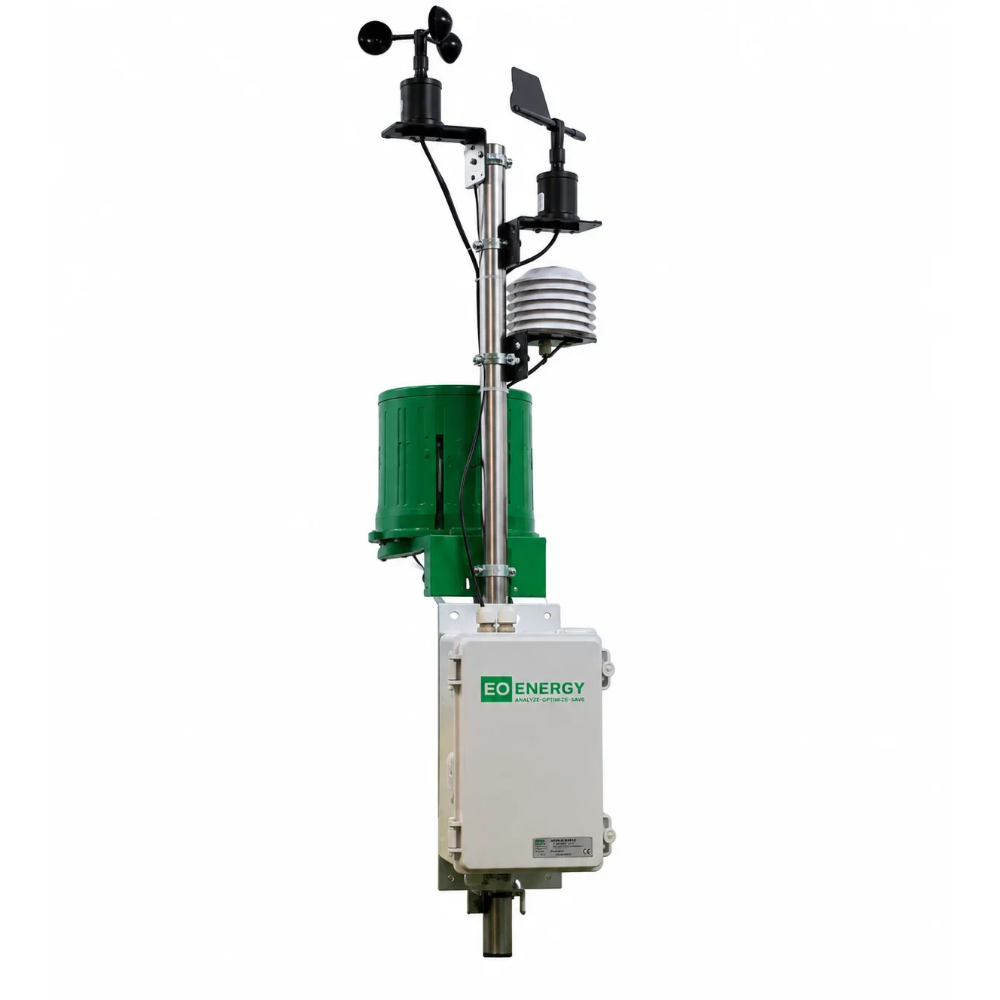
Automatic Weather Monitoring Station: Know the Weather at Your Site, Without Taking a Single Reading by Hand
Weather affects almost everything that happens outdoors. Wind carries dust and fumes across a site, rain changes how a site operates, heat and humidity change how people and machines perform, and sudden changes can disrupt plans. Relying on forecasts for a nearby town does not tell you what is happening at your exact location. The Automatic Weather Monitoring Station from EOEnergy Pvt. Ltd. is designed to measure the weather at your site, continuously and on its own, so you have accurate local information whenever you need it.
What Is an Automatic Weather Monitoring Station?
An automatic weather monitoring station is a fixed outdoor installation that measures weather conditions and records them without manual effort. Depending on the configuration, it can measure wind speed, wind direction, air temperature, relative humidity, rainfall, atmospheric pressure and solar radiation. The sensors are mounted on a mast or frame, and a data logger collects the readings and stores them over time.
It is important to understand what the station does. It measures and records weather conditions at its location. It does not forecast the weather or change it. Its purpose is to give you reliable local data, so you can see what is happening at your site and act on it.
How Does It Work?
Each sensor measures one condition. An anemometer and wind vane track wind speed and direction, a temperature and humidity sensor measures the air, a rain gauge collects rainfall, and other sensors can be added for pressure or sunlight. A data logger takes the signals from all the sensors, records them at regular intervals and stores them. Depending on the configuration, the data can be viewed on site, downloaded, or sent to a server or cloud platform for remote viewing. Alerts can also be set to flag when a reading goes above or below a chosen level.
Why Local Weather Monitoring Matters
Weather can differ a great deal from one place to another, and a forecast for a distant station may not reflect your site. Local measurement gives you facts rather than estimates.
Wind data is especially valuable. Wind speed and direction show where dust, smoke or odours are likely to travel, which is why weather data is often used together with air quality monitoring. Rainfall records help in planning work, managing drainage and reviewing site conditions. Temperature and humidity readings help in planning operations, protecting equipment and checking comfort and safety. Over months and years, the stored data builds a clear picture of how conditions at your site change through the seasons.
Key Benefits
Automatic and continuous: Measures around the clock without manual readings.
Local and accurate to your site: Shows the conditions at your location instead of relying on distant forecasts.
Several parameters in one station: Wind, temperature, humidity, rainfall and more can be combined, depending on the configuration.
Records and trends: Stored data makes it easy to review patterns, compare periods and prepare reports.
Remote access and alerts: Depending on the configuration, you can view data from anywhere and receive alerts without visiting the site.
Works with air quality monitoring: Weather data helps explain changes in pollution levels, so it pairs well with our ambient air quality products.
Flexible configuration: The sensors can be chosen to match what you actually need to measure.
Where Can It Be Used?
Automatic weather monitoring stations are used in industrial estates and factories, power plants, cement and steel plants, mines and quarries, construction and infrastructure projects, ports and airports, farms and greenhouses, solar and wind energy sites, schools and colleges, research projects, and city or neighbourhood locations where local weather data is useful. Any site that benefits from knowing its own weather can use one.
Weather Station and Air Quality Monitoring Together
A weather station measures conditions in the air, not what is in it. If you also want to track dust and gases, our Continuous Ambient Air Quality Monitoring Station measures the quality of outdoor air at a fixed site, and our Portable Air Quality Monitoring System is suited to spot checks at different places. Using weather and air quality data together shows not only how polluted the air is but also why levels rise and where the pollution may be travelling. Our team can help you decide which combination suits your site.
Choosing the Right Configuration
The right configuration depends on what you want to track. Please keep these details ready: the type of site, the weather parameters you need, the height at which sensors should be mounted, whether you want remote data access and alerts, and the power and internet connectivity available at the location. We can guide you on the right configuration for your purpose.
Installation and Support
For reliable readings, the station should be placed in an open area, away from buildings, trees and walls that could block the wind or affect temperature readings, and installed according to the manufacturer’s guidance. Like any measuring instrument, sensors need regular checks, cleaning and calibration to stay accurate. Our team can guide you on location, installation and setup, and support is available for servicing and operating questions after installation.
Why Choose EOEnergy?
EOEnergy Pvt. Ltd. is a manufacturer and supplier of power solution and environmental equipment, including generators, retrofit emission control devices and dual fuel kits, along with air pollution control devices, flowmeters and monitoring systems. This lets us support your weather, air quality, emission and monitoring needs from one source.
Frequently Asked Questions
1. What is an automatic weather monitoring station?
It is a fixed outdoor installation that measures weather conditions such as wind, temperature, humidity and rainfall, and records them automatically.
2. Does it forecast the weather?
No. It measures and records the conditions at its location. It gives you accurate local data, but it does not predict future weather.
3. Which parameters can it measure?
Depending on the configuration, it can measure wind speed, wind direction, temperature, humidity, rainfall, atmospheric pressure and solar radiation. Please share what you need and we will guide you on the configuration.
4. Why is wind data important for air quality?
Wind speed and direction show where dust and pollutants are likely to travel. Combining weather data with air quality readings helps explain why pollution levels rise or fall.
5. Can I see the data remotely?
Depending on the configuration, the data can be sent to a server or cloud platform so you can view it from anywhere. Please tell us your requirement.



 Total views : 1991

Reviews
There are no reviews yet.