
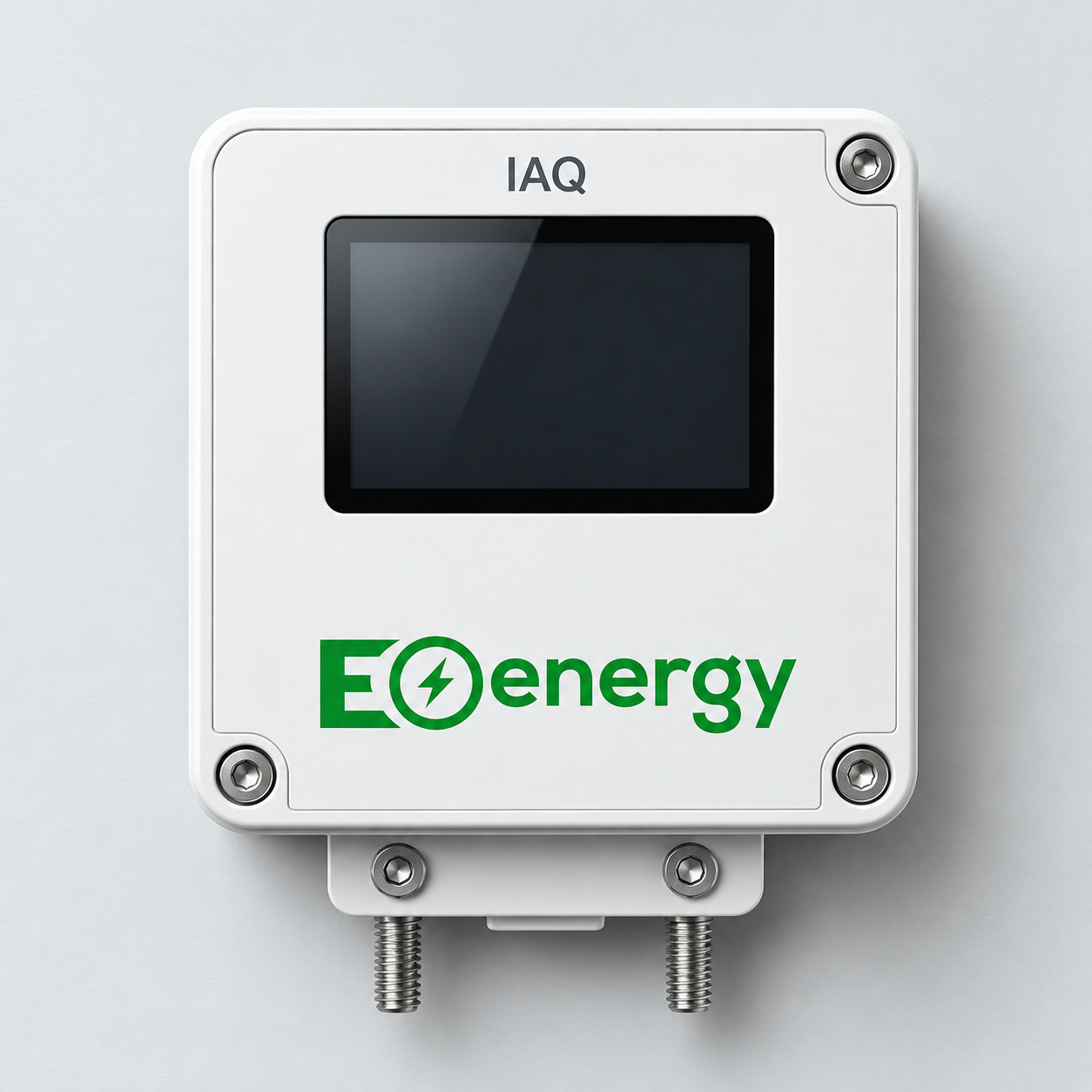
Indoor Air Quality Monitor: Know What Is in the Air You Breathe Indoors
We spend most of our day indoors, in offices, classrooms, hospitals, shops, factories and homes. The air inside these spaces can carry fine dust, stale air with too much carbon dioxide, and gases released from paints, furniture, cleaning products and machinery, often without any smell or visible sign. The Indoor Air Quality Monitor from EOEnergy Pvt. Ltd. is designed to measure the quality of indoor air continuously, so you can see how your space is really doing and act when it needs attention.
What Is an Indoor Air Quality Monitor?
An indoor air quality monitor is a compact instrument that measures the condition of the air inside a room or building. Depending on the model, it can measure fine dust particles such as PM2.5 and PM10, carbon dioxide (CO₂), volatile organic compounds (VOCs), temperature and humidity. The readings are shown on a display and stored over time, so you can see not just the current condition but also how it changes through the day.
It is important to understand what the monitor does. It measures and reports the air quality. It does not clean or purify the air. Its purpose is to give you reliable information so that you can decide when to improve ventilation, change filters or look for sources of pollution.
How Does It Work?
The monitor uses sensors to check the surrounding air for the chosen parameters. A built-in processor converts the sensor signals into readings, shows them on the display and saves them at regular intervals. Depending on the model, the data can also be sent to a computer, app or cloud platform for remote viewing, and alerts can be set to flag when a reading goes above a chosen level.
Why Indoor Air Monitoring Matters
Closed spaces can build up pollutants quickly, especially when many people share a room, ventilation is poor, or dust and fumes are generated by activities nearby. For example, carbon dioxide levels often rise in crowded rooms with little fresh air, which is why CO₂ is commonly used as an indicator of ventilation. Monitoring helps facility managers, school administrators, hospital staff and business owners keep track of conditions, check whether ventilation and air handling systems are working as intended, and keep records where required.
Key Benefits
Continuous monitoring: Tracks indoor air around the clock instead of giving a single snapshot.
Ventilation insight: Helps you see when a room needs more fresh air.
Fuller picture of comfort: Temperature and humidity readings sit alongside air quality data.
Easy to read: A clear display shows live readings at a glance.
Records and trends: Stored data makes it easy to review patterns and prepare reports.
Alerts and remote access: Depending on the model, alerts and remote viewing help you respond without visiting the room.
Compact and simple: Small in size, easy to place and low on maintenance.
Where Can It Be Used?
Indoor air quality monitors are used in offices and co-working spaces, schools, colleges and coaching centres, hospitals, clinics and laboratories, malls, hotels and restaurants, factories and production halls, warehouses, server and data rooms, gyms and studios, and residential apartments. Any enclosed space where people spend long hours can benefit from knowing its air quality.
Indoor and Outdoor Monitoring
An indoor monitor is meant for the air inside a building. If you need to track outdoor air around your site, our Ambient Air Quality Monitoring System is the right product, and if you need a movable unit for spot checks, our Portable Air Quality Monitoring System may suit you better. Our team can help you pick the right one for your purpose.
Choosing the Right Monitor
The right model depends on what you want to track. Please keep these details ready: the type and size of the space, the parameters you want to monitor, whether you need a simple display or remote data access and alerts, and the power or connectivity available at the location. We can guide you on the right configuration and placement.
Installation and Support
For reliable readings, the monitor should be placed at a suitable height, away from windows, vents, doors and direct sources of heat or dust that could distort the results. Like any measuring instrument, sensors can drift over time and benefit from periodic cleaning and checks. Our team can guide you on placement and setup, and support is available for servicing and operating questions after installation.
Why Choose EOEnergy?
EOEnergy Pvt. Ltd. is a manufacturer and supplier of power solution and environmental equipment, including generators, retrofit emission control devices and dual fuel kits, along with air pollution control devices, flowmeters and monitoring systems. This lets us support your air quality, emission and monitoring needs from one source.
Frequently Asked Questions
1. What is an indoor air quality monitor?
It is a compact instrument that measures the condition of the air inside a room or building, such as dust particles, carbon dioxide, VOCs, temperature and humidity, and records the readings over time.
2. Does it clean or purify the air?
No. It only measures and reports air quality. It helps you decide when to improve ventilation, change filters or look for pollution sources, but it does not remove pollutants.
3. Which parameters can it measure?
Depending on the model, it can measure PM2.5, PM10, CO₂, VOCs, temperature and humidity. The exact list depends on the model and your requirement, so please share what you need to monitor.
4. Why is CO₂ measured indoors?
Carbon dioxide tends to build up in crowded rooms with limited fresh air, so it is commonly used as an indicator of how well a space is ventilated.
5. How is it different from an ambient air quality monitoring system?
An indoor monitor measures the air inside a building. An ambient air quality monitoring system measures outdoor air at a site, such as an industrial area or construction project. We offer both, so you can choose according to your need.


 Total views : 1991

Reviews
There are no reviews yet.