
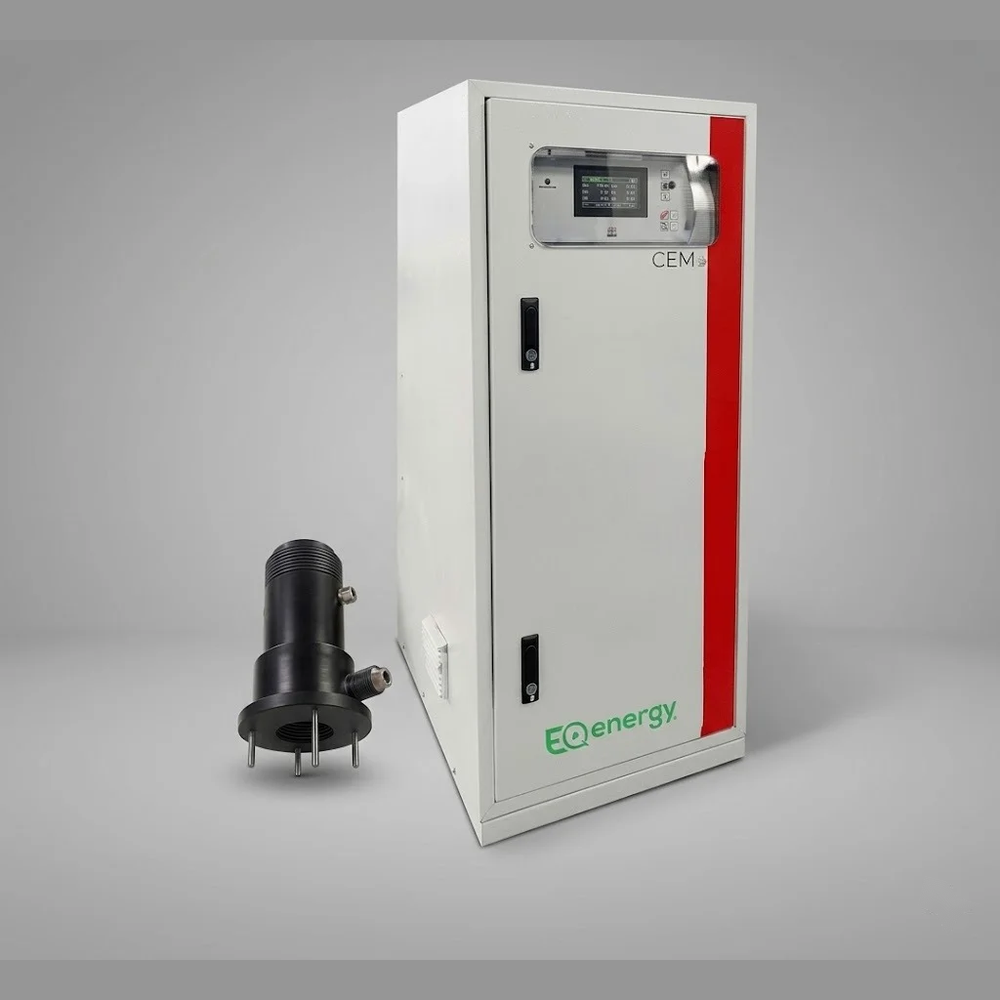
Continuous Emission Monitoring Station: See What Your Stack Is Releasing, Every Hour of the Day
Every boiler, furnace, generator, kiln and process unit sends gases and dust out through a stack. What comes out depends on the fuel, the process and how well the equipment is running, and it can change from hour to hour without any visible sign. A test done once a month shows only one moment. The Continuous Emission Monitoring Station from EOEnergy Pvt. Ltd. is designed to measure the emissions leaving your stack continuously, so you can see the real picture, act when levels rise and keep records you can rely on.
What Is a Continuous Emission Monitoring Station?
A continuous emission monitoring station is an installation fitted to a stack or chimney that measures the gases and particles leaving it and records the readings over time. Depending on the configuration, it can measure particulate matter (dust), gases such as sulphur dioxide (SO₂), oxides of nitrogen (NOx), carbon monoxide (CO) and carbon dioxide (CO₂), oxygen, and conditions such as gas flow, temperature and pressure inside the stack.
It is important to understand what the station does. It measures and reports emissions. It does not clean the gases or reduce pollution. Its purpose is to give you dependable data, so you can see how your plant is performing, check whether your control equipment is working and keep records where they are required.
How Does It Work?
A sampling probe or in-stack sensor takes the measurement from the flue gas. Depending on the design, a sample of the gas may be drawn out, conditioned and sent to an analyser, or the measurement may be made directly in the stack. Dust sensors measure particles, gas analysers measure the pollutants, and flow, temperature and pressure sensors provide the conditions needed to interpret the readings. A data logger collects all the signals and stores them at regular intervals. Depending on the configuration, the data can be viewed on site, downloaded, or sent to a server or cloud platform for remote viewing, and alerts can be set to flag when a reading goes above a chosen level.
Why Continuous Monitoring Matters
Emissions rarely stay constant. They change with load, fuel quality, equipment condition and the performance of pollution control devices such as filters and scrubbers. A bag filter may begin to leak, a burner may run out of tune, or a change in fuel may raise a gas level. A periodic test can easily miss these changes. Continuous monitoring shows them as they happen, so problems can be found and corrected early instead of being discovered long afterwards.
Continuous records also help in planning maintenance, checking the effect of improvements and keeping a clear history of how the plant has performed. Where regulations or permits require emission monitoring, a continuous system can support those requirements. The exact requirements depend on your industry and location, so please share them with us.
Key Benefits
Round-the-clock monitoring: Tracks emissions continuously instead of giving a single snapshot.
Early warning: Helps you notice rising levels quickly, so you can act before a small problem grows.
Checks your control equipment: Readings show whether filters, scrubbers and other devices are doing their job.
Records and trends: Stored data makes it easy to review performance, compare periods and prepare reports.
Remote access and alerts: Depending on the configuration, you can view data from anywhere and receive alerts without going to the stack.
Several parameters in one station: Dust, gases and stack conditions can be combined, depending on the configuration.
Flexible configuration: The parameters can be chosen to match your process and what you need to monitor.
Where Can It Be Used?
Continuous emission monitoring stations are used on boilers and furnaces, power plants, cement and steel plants, chemical and pharmaceutical units, textile and dyeing units, paper mills, foundries and metal industries, waste and biomass processing units, incinerators, diesel generator sets and other combustion and process units. Any plant that releases gases or dust through a stack can benefit from knowing what is leaving it.
Emission Monitoring and Ambient Monitoring: Which One Do You Need?
Different products measure different things, and it helps to choose the right one.
- Continuous Emission Monitoring Station (this product): measures what comes out of a stack or chimney.
- Continuous Ambient Air Quality Monitoring Station: measures the quality of the outdoor air around a site.
- Automatic Weather Monitoring Station: measures local weather such as wind, temperature and rainfall, which helps explain how pollution spreads.
- Portable Air Quality Monitoring System: a movable unit for spot checks at different places.
Many sites use emission and ambient monitoring together, so they know both what leaves the stack and what reaches the air around the plant. Our team can help you decide which combination suits your site.
Working with Pollution Control Devices
Monitoring and control work best together. If readings show that dust or gas levels are higher than you would like, our air pollution control devices, such as bag filters, venturi scrubbers, electrostatic precipitators and thermal oxidizers, can help reduce emissions. The monitoring station then shows whether the improvement is working.
Choosing the Right Configuration
The right configuration depends on your plant and what you need to track. Please keep these details ready: the type of unit and fuel, the stack size and height, the parameters you need to measure, any regulations or permit conditions that apply, whether you need remote data access and alerts, and the power and connectivity available at the location. We can guide you on the right configuration for your purpose.
Installation and Support
For reliable readings, the sampling point should be at a suitable position on the stack with safe access, installed according to the manufacturer’s guidance and any applicable rules. Like any measuring instrument, probes, sensors and analysers need regular checks, cleaning and calibration to stay accurate, especially in dusty or hot flue gas. Our team can guide you on location, installation and setup, and support is available for servicing and operating questions after installation.
Why Choose EOEnergy?
EOEnergy Pvt. Ltd. is a manufacturer and supplier of power solution and environmental equipment, including generators, retrofit emission control devices and dual fuel kits, along with air pollution control devices, flowmeters and monitoring systems. This lets us support your emission, monitoring and pollution control needs from one source.
Frequently Asked Questions
1. What is a continuous emission monitoring station?
It is an installation fitted to a stack or chimney that measures the gases and dust leaving it and records the readings over time.
2. Does it reduce emissions?
No. It only measures and reports emissions. It helps you see how your plant and control equipment are performing, but it does not remove pollutants.
3. Which parameters can it measure?
Depending on the configuration, it can measure dust, SO₂, NOx, CO, CO₂, oxygen, gas flow, temperature and pressure. Please share what you need to monitor and we will guide you on the configuration.
4. How is it different from an ambient air quality monitoring station?
An emission monitoring station measures what comes out of a stack. An ambient station measures the outdoor air around a site. We offer both, so you can choose according to your need.
5. Can the data be viewed remotely?
Depending on the configuration, the data can be sent to a server or cloud platform so you can view it from anywhere. Please tell us your requirement.



 Total views : 1991

Reviews
There are no reviews yet.