
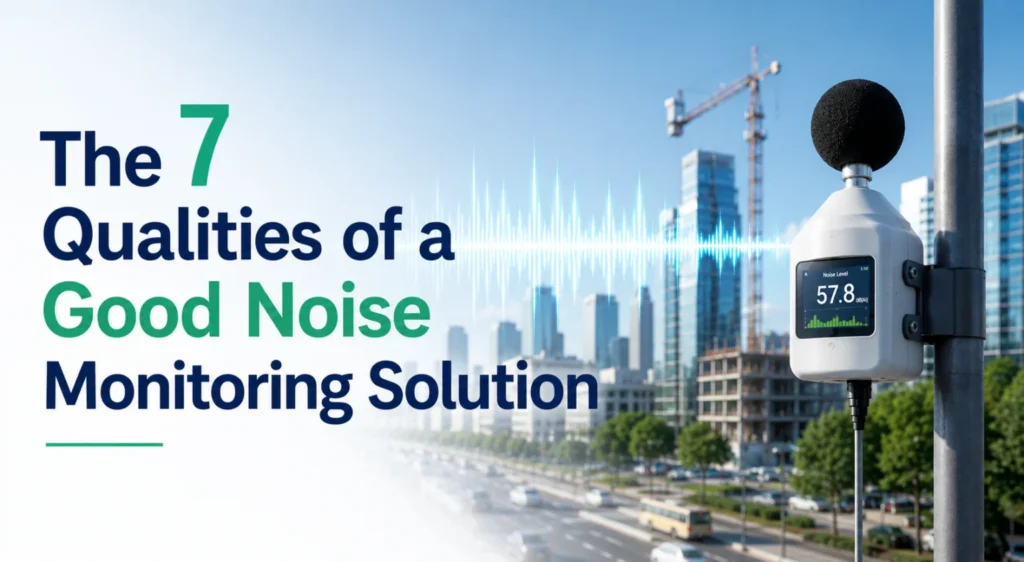
A good noise monitoring system combines real-time data accuracy, regulatory compliance, remote accessibility, durability, smart alerting, easy integration, and scalable reporting. These seven qualities set a real industrial-grade noise monitoring system apart from a simple decibel meter, and they are what differentiate between collecting data that actually helps you reduce noise pollution, avoid penalties, and protect public health.
If you’re evaluating a noise monitoring system for an industrial site, construction project, airport, or urban location, the wrong choice can mean inaccurate readings, missed violations, and wasted budget. This guide breaks down exactly what to look for, based on real-world deployment experience.
Why Choosing the Right Noise Monitoring System Matters
Noise pollution isn’t just an annoyance — it’s a measurable environmental and health hazard. The World Health Organization has linked prolonged exposure to high noise levels with cardiovascular issues, sleep disruption, and reduced productivity. In India, the Central Pollution Control Board (CPCB) mandates ambient noise standards across industrial, commercial, residential, and silence zones.
A poorly designed monitoring setup gives you numbers — but not insight. A well-engineered one gives you actionable, defensible, real-time data that supports compliance audits, community trust, and operational decision-making.
Here are the seven qualities that matter most.
1. Measurement Accuracy and Calibration Standards
Accuracy is the foundation. Without it, every other feature is irrelevant.
A reliable system should:
- Meet IEC 61672 Class 1 or Class 2 standards for sound level meters
- Offer factory calibration certificates and support periodic recalibration
- Capture data across the full audible spectrum (20 Hz–20 kHz) without distortion
Expert insight: Many low-cost sensors drift in accuracy after just a few months of outdoor exposure. Look for vendors who specify recalibration intervals upfront — typically every 12 months for field-deployed units.
2. Real-Time Data Collection and Remote Access
Manual, periodic noise checks are outdated. Modern facilities need continuous, 24/7 monitoring accessible from anywhere.
A strong noise monitoring system should offer the following:
- Live dashboards accessible via web or mobile
- Cloud-based data logging with historical trend access
- Remote diagnostics, so you don’t need a site visit to check sensor health
This is especially critical for construction sites, mining operations, and airports where noise levels fluctuate hour by hour and stakeholders demand transparency.
3. Smart Alerts and Threshold-Based Notifications
Data without alerts is just a log file. The best systems notify the right people the moment noise crosses a defined limit.
Look for:
- Configurable thresholds based on CPCB zone classifications (industrial, commercial, residential, silence)
- SMS, email, or app-based alerts for instant escalation
- Time-stamped event logs for audit trails
Practical example: A construction company operating near a residential zone can set a night-time threshold of 55 dB(A). If levels spike, the system flags it immediately—allowing corrective action before a complaint or violation occurs, rather than after.
4. Rugged, Weather-Resistant Build Quality
Outdoor and industrial environments are unforgiving. Heat, monsoon rain, dust, and vibration all degrade poorly built equipment.
A dependable noise monitoring system should have the following:
- IP65 or higher ingress protection rating
- Wind-shield-protected microphones to filter out wind noise interference
- Stable performance across a wide temperature range (typically -10°C to 60°C for Indian conditions)
| Build Feature | Why It Matters |
| IP65+ enclosure | Prevents dust/moisture damage |
| UV-resistant housing | Reduces degradation under direct sun |
| Anti-vibration mounting | Maintains measurement accuracy near machinery |
| Backup power/battery | Ensures uptime during outages |
5. Seamless Integration with Other Environmental Systems
Noise rarely exists in isolation. Most regulatory and ESG frameworks now require integrated environmental reporting—covering air quality, water, and noise together.
A good system integrates with:
- Ambient Air Quality Monitoring Stations (AAQMS)
- Continuous Emission Monitoring Systems (CEMS)
- Centralized environmental data platforms used for CPCB/SPCB reporting
This integration reduces manual reporting effort and creates a single source of truth for compliance teams—which matters more as regulators move toward consolidated digital reporting.
6. Scalable, Audit-Ready Reporting
Whether you’re managing one site or fifty, your noise monitoring data needs to convert into reports regulators and management actually trust.
Strong reporting capabilities include:
- Automated daily/monthly/annual compliance reports
- Exportable formats (PDF, Excel, CSV) for audits
- Historical trend graphs to demonstrate long-term compliance or improvement
- Multi-site dashboard views for organizations with several locations
Why this matters: During a CPCB or SPCB inspection, having instantly retrievable, tamper-evident historical data can be the difference between a smooth audit and a penalty notice.
7. Local Support, Installation Expertise, and After-Sales Service
Hardware is only half the equation. The other half is who installs it, calibrates it, and supports it when something goes wrong.
Evaluate vendors on:
- On-ground installation and commissioning support
- Availability of local service technicians (not just remote helpdesks)
- Spare parts availability and warranty terms
- Training for your internal EHS or compliance team
A system backed by responsive local support typically has far less downtime than one shipped with minimal onboarding.
Noise Monitoring System: Feature Comparison at a Glance
| Quality | Basic Decibel Meter | Industrial-Grade Monitoring System |
| Accuracy & Calibration | Manual, infrequent | IEC-compliant, scheduled recalibration |
| Real-Time Access | No | Cloud dashboard + mobile access |
| Alerts | None | Threshold-based instant alerts |
| Build Quality | Indoor-rated | IP65+, weatherproof |
| Integration | Standalone | Connects with AAQMS/CEMS |
| Reporting | Manual logs | Automated, audit-ready exports |
| Support | Limited | Local installation + service |
How EO Energy Approaches Noise Monitoring
At EO Energy, our noise monitoring system is engineered around these exact seven qualities—combining IEC-compliant sensors, real-time cloud dashboards, automated CPCB-aligned alerting, and rugged outdoor-rated enclosures suited to Indian industrial and urban environments. Our team also handles on-site installation, calibration, and ongoing technical support, so compliance teams get usable data—not just numbers.
FAQs
1. What is a noise monitoring system used for?
A noise monitoring system continuously measures ambient sound levels to track compliance with environmental noise regulations, identify pollution sources, and support data-driven decisions in industrial, construction, and urban settings.
2. What noise level is considered a violation under CPCB norms?
Limits vary by zone; for example, industrial areas typically allow up to 75 dB(A) during the day and 70 dB(A) at night, while silence zones permit only 50 dB(A) and 40 dB(A). respectively. A compliant noise monitoring system should be pre-configured with these zone-specific thresholds.
3. How is noise level measured?
Noise level is measured in decibels (dB), typically using the A-weighted scale, dB(A), which adjusts readings to reflect how the human ear perceives different frequencies. A microphone captures sound pressure variations, which a sound level meter or monitoring system converts into a decibel reading, often averaged over time as Leq (equivalent continuous sound level) to account for fluctuating noise rather than a single peak moment.
4. Can a noise monitoring system send real-time alerts?
Yes. Quality systems support threshold-based alerts via SMS, email, or app notifications, allowing teams to respond before a violation escalates or a complaint is filed.
5. Is a noise monitoring system necessary for small construction sites?
Yes, especially near residential zones. Even short-term projects can face complaints or regulatory action, and having documented noise data helps demonstrate compliance and resolve disputes quickly.
Conclusion
A good noise monitoring system isn’t defined by a single feature—it’s the combination of accuracy, real-time visibility, smart alerting, rugged build quality, system integration, audit-ready reporting, and dependable local support. Together, these seven qualities turn raw decibel readings into a tool you can actually trust for compliance, community relations, and operational planning.
If you’re evaluating options for your facility, construction site, or urban project, it’s worth comparing vendors against this checklist before making a decision.
Ready to upgrade your environmental compliance setup?
Explore EO Energy’s Noise Monitoring System to see specifications, get a site assessment, or speak with our technical team about the right configuration for your location.
Website: https://eoenergy.in/
Phone: 9650308753
Address: KANWAR INDUSTRIAL AREA VILLAGE- KANWAR, FARIDABAD- 121001