

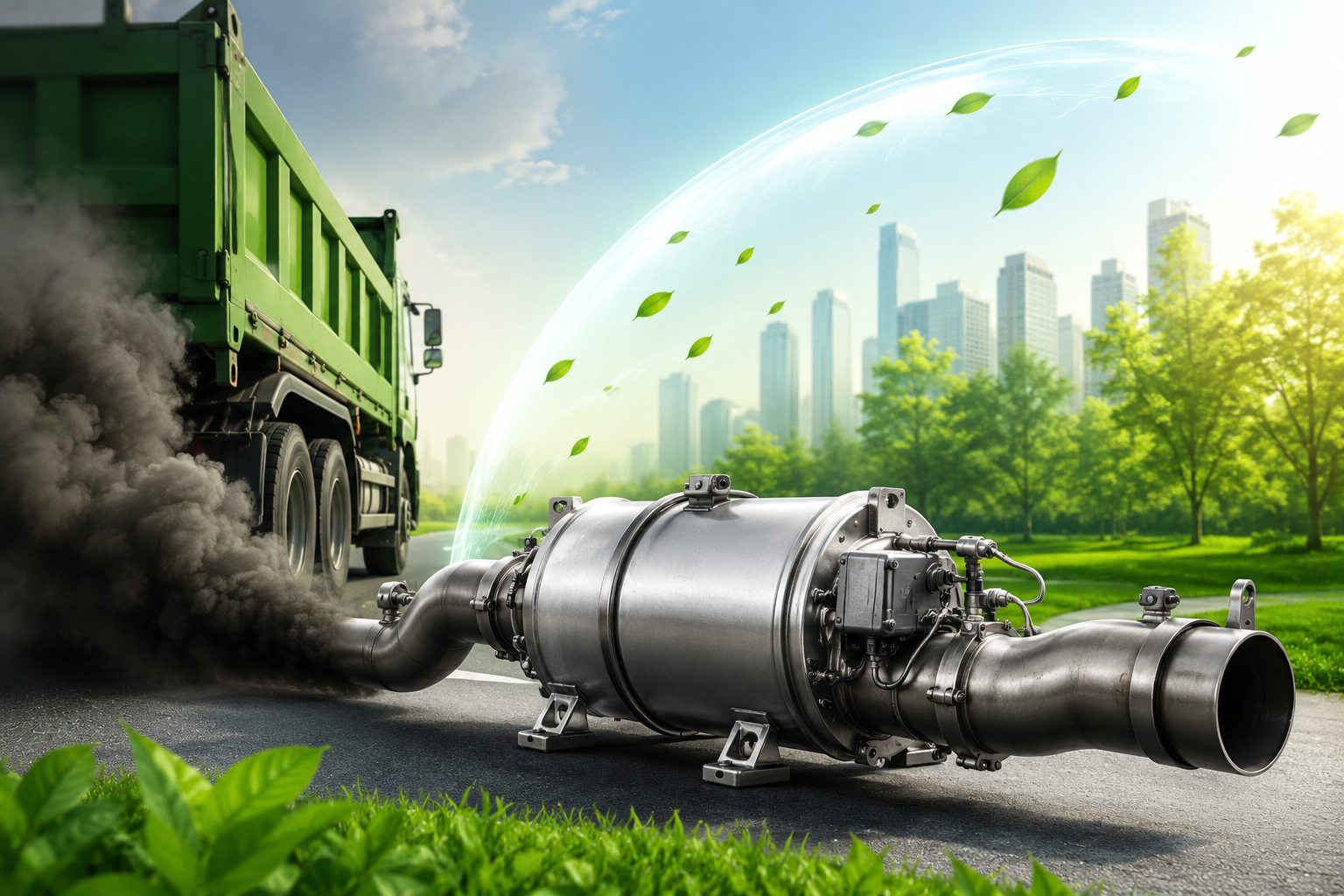
A RECD (Retrofit Emission Control Device) is an aftermarket emission control system installed on existing diesel generators (DG sets) to reduce harmful exhaust pollutants, including particulate matter (PM), nitrogen oxides (NOx), and hydrocarbons (HC). Mandated by India’s Central Pollution Control Board (CPCB), RECD is the most practical, cost-effective way to bring older diesel engines into compliance with current environmental norms without replacing the entire generator.
Why Diesel Emissions Are a Growing Concern in India
India runs on diesel generators. From hospitals and data centers to factories and commercial complexes, diesel-powered DG Sets serve as the backbone of backup power across the country. But this dependence comes at a steep environmental cost.
Uncontrolled diesel exhaust is one of the primary contributors to urban air pollution, releasing fine particulate matter (PM2.5), black carbon, nitrogen oxides, and volatile organic compounds directly into the atmosphere. In cities like Delhi, Mumbai, and Bengaluru, diesel generators operating without emission controls make a measurable dent in air quality indices.
This is precisely where Retrofit Emission Control (RECD) enters the picture. Rather than asking industries to scrap millions of functional generators, the CPCB introduced a smarter solution: a retrofittable device that cleans up the exhaust at the source.
What Exactly is a Retrofit Emission Control Device (RECD)?
A retrofit emission control device is a pollution abatement system fitted to the exhaust outlet of an existing diesel generator set. It is designed to trap, neutralize, or chemically convert pollutants before they escape into the atmosphere.
The word “retrofit” is key here. Unlike OEM (Original Equipment Manufacturer) emission systems that are built into new engines at the factory, RECD is added after the fact—making it applicable to the massive installed base of older diesel generators already in service across India.
RECD units are designed to handle generators ranging from small 10 kVA sets to large industrial units up to 2500 kVA, covering virtually every application where diesel power is used.
Key Pollutants That RECD Targets
Diesel exhaust is a complex mixture. The primary pollutants that RECD systems are engineered to address include:
- Particulate Matter (PM / PM2.5 / PM10): Fine soot particles that penetrate deep into the lungs and are directly linked to cardiovascular and respiratory diseases.
- Nitrogen Oxides (NOx): A group of gases that contribute to smog formation and acid rain.
- Hydrocarbons (HC): Partially burned fuel compounds, many of which are toxic or carcinogenic.
- Carbon Monoxide (CO): A colorless, odorless gas produced by incomplete combustion.
- Black Smoke / Opacity: The visible dark exhaust that signals unburned carbon particles.
How Does RECD Work? The Science Behind Emission Reduction
A well-engineered RECD system typically combines multiple emission control technologies within a single compact unit. Here’s how the process works:
1. Diesel Oxidation Catalyst (DOC)
The exhaust gases first pass through a diesel oxidation catalyst, a substrate coated with precious metals like platinum and palladium. The DOC oxidizes carbon monoxide (CO) into CO₂ and converts unburned hydrocarbons into water vapor and carbon dioxide. It also oxidizes soluble organic fractions of particulate matter, significantly reducing their concentration.
2. Diesel Particulate Filter (DPF)
After the DOC stage, exhaust passes through a diesel particulate filter, a ceramic or silicon carbide filter that physically traps fine soot and ash particles. Modern DPFs can capture over 85–95% of particulate matter by mass. Accumulated soot is periodically burned off through a process called regeneration, keeping the filter functional over extended periods.
3. Selective Catalytic Reduction (SCR) — For NOx Control
In higher-end SCR configurations, selective catalytic reduction technology is used to reduce NOx emissions. A urea-based solution (AdBlue or Diesel Exhaust Fluid) is injected into the exhaust stream, where it reacts with NOx in the presence of a catalyst to produce harmless nitrogen gas (N₂) and water (H₂O). SCR systems can achieve NOx reduction efficiencies of 70–90%.
4. Integrated Control Unit
Modern RECD systems come with an electronic control module that monitors exhaust temperature, back pressure, and system performance in real time. This ensures the device operates within optimal parameters, triggers regeneration cycles when needed, and provides data for compliance reporting.
CPCB Regulations and Why RECD Compliance Is Non-Negotiable
The Central Pollution Control Board (CPCB) has made RECD mandatory for diesel generator sets operating in areas with high pollution levels, particularly in non-attainment cities that have consistently failed to meet National Ambient Air Quality Standards (NAAQS).
Under CPCB’s directives, DG sets of 800 kVA and above are required to install CPCB-approved RECDs. State Pollution Control Boards in several states have extended this requirement to smaller generator capacities as well, reflecting the urgency of the problem.
Operating a DG Setting without a compliant RECD where mandated can result in
- Notices and penalties from pollution control authorities
- Shutdown orders for the generator
- Difficulty in obtaining or renewing Consent to Operate (CTO) certificates
- Reputational risk for businesses with environmental, social, and governance (ESG) commitments
For businesses, the question is no longer whether to install RECD—it’s which RECD to choose.
Practical Benefits of Installing RECD on your DG Set
Beyond regulatory compliance, RECD delivers tangible operational and environmental advantages:
Significant Emission Reduction: A properly installed RECD can reduce particulate matter emissions by up to 70–90%, black smoke (opacity) by over 80%, and NOx by 70% or more, depending on the technology configuration.
No Engine Modification Required: RECD is installed on the exhaust system, which means the engine itself remains untouched. This preserves warranty conditions and avoids the complexities of internal engine work.
Improved Fuel Efficiency: A cleaner combustion profile, supported by optimized back-pressure management in good RECD designs, can marginally improve fuel consumption — a benefit that accumulates meaningfully over extended generator operation hours.
Lower Maintenance Costs Over Time: By reducing carbon build-up in exhaust pathways and improving combustion quality, RECD can extend the service intervals of associated components.
ESG and Sustainability Reporting: For companies tracking their carbon footprint or reporting under GRI, BRSR, or similar frameworks, RECD provides verifiable emission reduction data — a meaningful contribution to sustainability goals.
RECD System Specifications at a Glance
| Parameter | Details |
| Applicable Generator Range | 10 kVA to 2500 kVA |
| Primary Pollutants Addressed | PM, NOx, HC, CO, Black Smoke |
| PM Reduction Efficiency | Up to 70–90% |
| NOx Reduction Efficiency | Up to 70–90% (with SCR) |
| Installation Type | Retrofit (no engine modification) |
| Regulatory Approval | CPCB Type Approval |
| Maintenance | Periodic filter regeneration / inspection |
| Monitoring | Electronic control unit with real-time diagnostics |
Why Choose EO Energy for RECD?
EO Energy is a CPCB-approved manufacturer and supplier of retrofit emission control devices for diesel generators across India. With a product range covering DG sets up to 2500 kVA and a team of qualified engineers handling design, manufacturing, installation, and after-sales support, EO Energy offers a single-window solution for emission compliance.
What sets EO Energy apart is its end-to-end approach—from site assessment and capacity-matching to installation, commissioning, and ongoing maintenance support. The company’s CPCB type approval certificate validates that its RECD systems meet the Board’s stringent performance and quality benchmarks, giving businesses the assurance they need for regulatory filings and audit documentation.
EO Energy serves clients across industries, including hospitals, manufacturing plants, IT parks, educational institutions, and residential complexes—anywhere diesel backup power is essential and emission standards must be met.
Conclusion
India’s air quality challenge is real, and diesel generators are a significant part of that equation. Retrofit Emission Control (RECD) is not just a compliance checkbox; it is a proven, engineering-backed solution that dramatically reduces the environmental footprint of diesel power generation without disrupting operations or requiring major capital investment in new equipment.
For businesses navigating CPCB mandates, ESG commitments, or simply a genuine desire to operate cleaner, RECD represents the most practical path forward available today.
FAQs
1. What does RECD stand for, and what is its full form?
RECD stands for Retrofit Emission Control Device. It is an after-market pollution control system installed on the exhaust of existing diesel generators to reduce emissions of particulate matter, nitrogen oxides, hydrocarbons, and black smoke in compliance with CPCB norms.
2. Is RECD mandatory for all diesel generators in India?
CPCB has mandated RECD for DG sets of 800 kVA and above in non-attainment cities. However, several state pollution control boards have issued directives extending the requirement to smaller capacities. If you operate a diesel generator and are based in a high-pollution urban area, it is strongly advisable to check the applicable local norms and consult a CPCB-approved RECD vendor.
3. Will installing RECD affect my generator’s performance or power output?
No. A correctly designed and installed RECD does not affect your generator’s power output. The system works entirely within the exhaust pathway. EO Energy’s RECD units are engineered with careful back-pressure management to ensure the generator continues to operate at rated capacity.
4. How often does an RECD system need maintenance?
Maintenance requirements vary by usage and load profile but generally involve periodic inspection of the filter unit, regeneration of the diesel particulate filter when required, and checks on the electronic control system. EO Energy provides comprehensive maintenance support post-installation.
5. Can RECD be installed on any make or model of diesel generator?
RECD is designed as a universal retrofit system and can be fitted to most makes and models of diesel DG sets. EO Energy offers custom-configured units for generator capacities from 10 kVA to 2500 kVA, covering all major brands. A technical assessment is recommended prior to installation to ensure the right system configuration.
Contact Us
Looking for reliable and CPCB-approved emission control solutions for your industrial operations? Connect with EO Energy for expert guidance and advanced RECD systems tailored to your business needs.
Contact Us today to learn more about cleaner, safer, and more efficient emission control solutions for your industry.
Follow us on social media for more updates: Facebook and Instagram.


 Total views : 24421